
This blog post offers an in-depth review of the 2026 AI Impact Summit in India, held in New Delhi, as well as the “Innovation Workshop on the GPAI India Student Community Project” that took place there. Departing from the usual format of our publications, this contribution takes the form of an analytical and reflective report, informed by field experience and interdisciplinary exchanges. The author presents his main contributions to the workshop’s proceedings, the key issues that emerged from the discussions, and several avenues for reflection regarding the responsible governance of artificial intelligence in an international context.
To introduce myself briefly, I am a master’s student in philosophy at the University of Montreal under the supervision of Prof. Jonathan Simon. I am also a lawyer specializing in information governance and cybersecurity, having worked in recent years in the field of cyberjustice on issues related to digital technologies and artificial intelligence (AI). In my practice I focus on the impact of new technologies on law, governance, and access to justice. I have also completed a Master of Business Administration (MBA). Academically, my interests focus primarily on artificial intelligence, considered from both philosophical and legal perspectives, as well as ethics, governance, and international law. I have had the opportunity to work for various professors of philosophy and law as a research assistant, and I am currently exploring issues related to the metaphysics of the person and the potential attribution of rights to advanced AI systems, questioning their capacity to act and their legal status (as both objects and subjects of law).
Photo of the main logo for the 2026 AI Impact Summit in India
It is in this context that I was selected by the Montreal International Center of Expertise in Artificial Intelligence (CEIMIA) to participate in the Innovation Workshop on GPAI India Student Community Project (hereinafter, the “Workshop”) presented as part of the India AI Impact Summit 2026 (India AI Impact Summit 2026 – hereinafter, the “Summit”), held in New Delhi on February 18, 2026. I was assigned to Group No. 5, which focused on the issue of training and empowering users and developers of artificial intelligence (AI) systems (Training and Empowerment of Users and Developers). My learnings extend beyond the discussions within this group and stem from various conversations I had with numerous students, colleagues, professors, and researchers from diverse academic backgrounds (both technical and non-technical) throughout the Summit. This brief report will first provide a short description of the Workshop and its objectives (1), then present my main contributions to the exercise (2), and finally outline the insights and observations that struck me as most significant throughout the Summit (3).
1. My arrival at the Innovation Workshop on GPAI India Student Community Project
In terms of its founding principles, the Workshop was based on the simple and rather intuitive guiding principle that AI has become a tool with far-reaching societal implications, capable of opening up new perspectives by accelerating certain processes (including repetitive ones), by providing support in tooling and the analysis of complex problems, and by making certain concepts – which are otherwise difficult to grasp – more concrete (for example, through the development of applications designed to solve specific problems or offer new functionalities by transforming an idea into a functional product). However, this capacity to extend into dimensions not yet envisaged has been accompanied by an asymmetric risk highlighted by the Workshop: depending on the context, AI can exacerbate disparities between individuals, communities, and regions, particularly based on demographic, cultural, socioeconomic, and, of course, political factors. In this context, the Workshop provided students with a structured space for sharing and discussion dedicated to their individual and intersubjective experiences, as well as for collective reflection and deliberation aimed at proposing solutions rooted locally in their national contexts, while remaining sufficiently flexible to contemporary multilateral and geopolitical dynamics. Rather than aiming to produce fully formed policy proposals, the exercise focused on raising foundational questions by effectively engaging participants and stimulating their creativity – by bringing their perspectives together – and on identifying some of the potential next key steps in responsible AI that could fuel discussions within international scientific and practitioner communities.
From a more methodological perspective, the Workshop aimed to engage university students, guided by professors and researchers, in addressing the key challenges and trends associated with AI, using a prioritization (hierarchical) approach that examines strategic opportunities to be developed and potentially leveraged, with the goal of strengthening the trust of diverse – and sometimes fragmented and marginalized – communities in AI systems. Throughout the discussions, participants gathered and synthesized ideas on fundamental themes of responsible AI, ranging from technical and organizational dimensions (e.g., governance, data quality and extraction, bias reduction, explainability of results, safety and security of processes) to more cross-cutting and socio-legal issues (e.g., discrimination, the role of authorities and institutions, understanding users and raising awareness of their actions, the impact of AI systems on operational and procedural decisions specific to the fields of law and governance). The objective was therefore not to establish a single, standardized model of responsible AI, but to actively promote an algorithmic architecture for future AI systems that is both ethically oriented (i.e., incorporating a deontological dimension clarifying the social relationships of duties, responsibilities, and user accountability), robust and scalable (i.e., capable of being revised as uses and contexts change, implying somewhat porous boundaries with the domains affecting it), and compliant with the law (i.e., compatible with applicable legal and governance requirements).
Finally, from a more applied and practical standpoint, the diversity of the student communities engaged in the Workshop – hailing notably from India, Japan, France, Mexico, several African countries, and Canada – combined with the pedagogical framework provided, made it possible to translate highly abstract concerns into very concrete issues. Based on a reverse mentoring approach, placing student contributions on an equal footing with those of more institutional actors (decision-makers, researchers), the Workshop gave rise to structured reflections, the sketching of essential prototypes (in my view) for AI governance, and the formulation of recommendations aimed at addressing certain challenges at the interface of AI and society. As such, it has helped to enrich (modestly, but perhaps usefully) the pool of ideas on AI that currently informs work in international governance, applied ethics, and technological diplomacy.
2. A few contributions to the workshop, through collaboration and discussion
My contributions to this Workshop can be summarized in three main points: (i) participation in the development of a common vocabulary regarding the roles of “developers” and “users” (2.1.); (ii) the presentation of some of the key challenges amplified by AI, including the gap between academia and industry, which AI significantly contributes to, ethical and legal concerns regarding the concepts of ownership and liability, the cross-cutting issue of biases inherent in many AI systems, and certain resource constraints, including environmental ones (2.2.); and (iii) the proposal of an operational action framework that drew on specific areas of intervention and best practices (2.3.).
2.1 Development of a common vocabulary: the roles of “developers” and “users”
To begin with, one of my first contributions to the Summit Workshop focused on the importance of collectively establishing a shared and practical vocabulary to avoid the misunderstandings that often arise from the intuitive use of technical terms without a proper conceptualization process having been carried out beforehand. This perspective therefore led us to establish a clear and unambiguous definition of the concepts of “developer” and “user” of AI systems.
We quickly concluded, in line with the spirit of certain contemporary regulatory approaches (including the general direction of the European framework established notably by the EU AI Act), that the term “developer” included (unsurprisingly) technical professionals working with and studying the technology and its many dilemmas and mechanistic complexities, such as engineers, computer scientists, mathematicians, physicists, and other scientists specializing in machine and deep learning (including reinforcement learning), system architecture (symbolic – with little concern for human cognition – vs. connectionist – seeking to emulate distinctly human cognitive processes), and cybersecurity, among other things (e.g., through “black-box” and “white-box” testing, and the analysis of the validation, robustness, performance, and explainability of AI systems). Subsequently, we expanded this concept to include non-technical stakeholders, such as policymakers and policy experts, lawyers and legal professionals, philosophers, sociologists, anthropologists, and other specialists from the humanities and social sciences who help define the objectives, constraints, limits, safeguards, and governance mechanisms within these systems. We thus unanimously concluded that the development and production of an AI system remains a fundamentally collective process in which responsibility is distributed among its various actors (technical and social), and whose quality depends both on technical considerations and on the normative and organizational choices that frame it.
In the same vein, we then agreed to treat the category of “users” as a stratified rather than a homogeneous group, distinguishing two profiles: (i) users with sufficient familiarity with the technological ecosystem and its mediations (interfaces, parameters, implicit models), and (ii) users with limited digital literacy. This distinction seemed necessary to us given the degree of autonomy available to these two categories of users – whether or not they are capable of supporting advanced uses (e.g., “second-order” operations: understanding risks and limitations, verification and auditability of processes, interpretation of results) or, at the very least, to ensure secure basic usage (e.g., informed consent, vigilance against errors, ability to seek recourse in the event of disputes or operational irregularities), does not reflect the same potential for system usage and could foster the development of biases inherent to its operation, depending entirely on the profile of the users employing it: a public less accustomed to these technologies is more prone, due to lack of understanding or misunderstanding, to confuse what falls within the realm of probability rather than certainty, to reify categories produced by the system, or to take its results as neutral descriptions rather than contextually situated inferences. These mechanisms can foster “usage biases” (as opposed to design biases and training biases); that is, biases produced by the interaction between the tool and its users (errors of interpretation, misidentification of information, lack of corrective feedback).
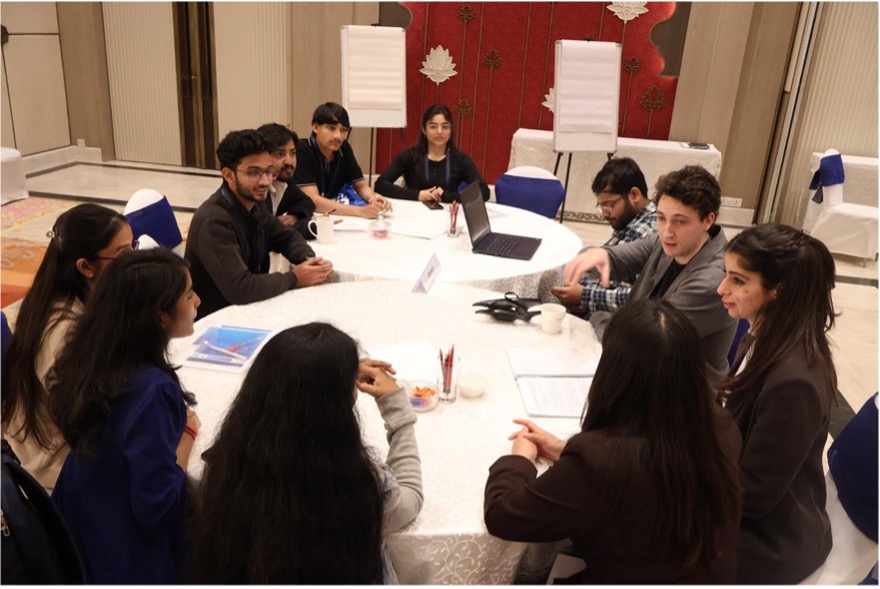
Photo of a discussion session among members of Group 5, to which I was assigned, as we sought to distinguish between the roles of “developer” and “user” of an AI system
For example, users might not realize that certain training data used by the AI, or even an initial design flaw in the system’s AI algorithm, contributed to denying them opportunities (e.g., an AI system evaluating job applications received by an employer), misidentifying them in documents (e.g., an AI system’s unoptimized automated facial recognition surveillance algorithm), or punishing them unfairly (e.g., due to a sentencing algorithm in an improperly deployed system). In this regard, various technical approaches aimed at mitigating these risks are gradually emerging, such as the “theory of jurisprudential constraint,” which seeks to examine how machine learning systems rely on training data to make decisions and, in doing so, to scrutinize the biases arising from their operation. Ultimately, this dynamic can undermine the system’s own effectiveness by reducing the frequency of corrections, fueling confirmation bias, and diminishing the collective ability to detect errors.
2.2 Some of the key challenges addressed by AI
Next, I helped the group identify certain challenges that AI exacerbates, and I contributed to formulating them in a structured way to facilitate their resolution through potential governance measures and training programs for developers and users. First, the group highlighted the already present the gap between academia and industry, which AI tends to accentuate. Consider, for instance, the asymmetry caused by the lack of access to data, adequate and democratized computing power, the availability of accessible testing environments, and the differences in timing (publication vs. market launch), language (scientific rigor vs. product constraints), and incentives (open knowledge vs. competitive advantage) that abound across various markets and sectors involving AI (often dependent on the socio-economic context in which they emerge and develop).
Second, we raised ethical and legal concerns related to property rights and the concept of control. As I understand it, beyond the issue of formal intellectual property (which, incidentally, remains unresolved in many cases – for example, the question of who is the true owner of the AI system: the designers and developers, shareholders, directors, etc., remains unresolved in many situations), effective control of the system (i.e., who decides on the purposes, uses, parameters, updates, and removal etc., of the AI system) often becomes an issue where the lack of a clear answer points to a governance issue of responsibility, rather than a simple matter of “ownership of rights” (i.e., the concept of responsibility cannot be reduced to a question of ownership).
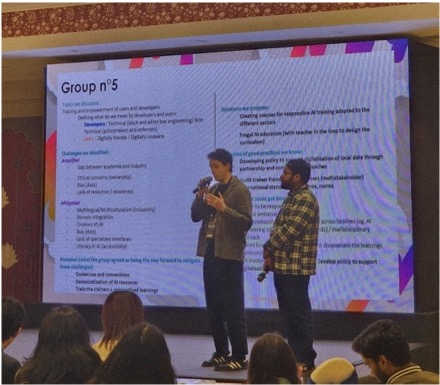
Photo of the presentation of our findings to all teams and the faculty and administrative staff responsible for organizing the Workshop
Third, the issue of bias, including bias in the use of the AI system (usage bias), the data and big data used to train the system and the collection methods employed (data bias), and model and omission biases (design and algorithmic architectural biases), has been identified as a cross-cutting issue, since it does not depend solely on the selected AI system model, but also on prior system configuration choices (definition of categories, data quality, representativeness, proxy variables), as well as on evaluation and deployment practices.
Fourth, the group emphasized (albeit rather discreetly, in my view) resource constraints, particularly environmental and climate-related ones (energy consumption, ecological footprint, computational costs, resource scarcity), and the lack of awareness regarding the typically indiscriminate and sometimes ill-considered deployment of new AI systems, including generative AI, in the absence of adequate regulatory frameworks. This, in my view, echoes the very contemporary trend toward adopting “default” solutions without first conducting a genuine analysis of necessity, impact, or alternatives.
2.3 Proposal for a framework of actionable practices
Third, building on the conceptual framework outlined above, I sought to shift the discussion slightly toward a more forward-looking perspective, with the aim of identifying a course of action capable of mitigating the challenges we had collectively identified. I therefore proposed structuring our discussion around three complementary pillars: (i) the establishment of clear, consistent, and inspiring guidelines and conventions that can serve as shared benchmarks extending beyond purely technical considerations; (ii) the democratization of AI resources – particularly access to data, infrastructure, tools, and skills – in order to reduce the asymmetries (including those mentioned earlier) that fuel the divide between sectors and regions; and (iii) the training of practitioners, decision-makers, and future users through tailored (personalized), differentiated learning pathways adapted to their specific contexts.
With this in mind, combined with the frequent and inspiring contributions from the Workshop’s various facilitators, we collectively proposed concrete areas of action and examples of best practices aimed at the ethical deployment of AI, which could potentially inspire the development of a responsible regulatory framework. I am thinking in particular of our idea of “context-adapted pedagogy,” centered on the creation of courses and outreach sessions on responsible AI and human rights, tailored to key sectors of activity (cultural, socioeconomic, political, and institutional) and capable of adapting content (e.g., risks, uses, limits, recourse mechanisms) to the profiles of the various stakeholders.
In the same vein, I emphasized the importance of implementing policies aimed at supporting the digitization and utilization of local data under the threefold principle of data access, data quality, and data integrity, through structural partnerships and community awareness initiatives, so that ecosystems less favored by the current techno-economic landscape can still formally participate in the development and use of AI systems, rather than being relegated to a passive role as mere “deployment markets.” I also highlighted the value of establishing multi-stakeholder audit mechanisms, including frameworks for evaluating training programs (trainers, content, methods, and outcomes), with the aim of improving the quality of learning and reducing the risks of disseminating superficial or biased approaches. Finally, I sought to reiterate what I believe must serve as the normative core of a truly integrated, clear, well-defined, and sufficiently flexible approach to contemporary international dynamics: a reference framework composed of international guidelines promoting state multilateralism, capable of structuring a responsible post-national governance and regulatory regime in AI, emphasizing the fundamental requirements of transparency, accountability, and the protection of rights.
As other directly actionable engagement measures, we proposed the practice already widespread in Europe and North America of designating, within organizations, an “ethical leader” – or responsible governance leader – tasked with embodying, overseeing, and applying normative requirements in day-to-day decisions. To this end, I exposed several ideas, including that of a “philosopher-in-residence ” (following the model of certain initiatives observed in large techno-managerial ecosystems such as that of the American company Anthropic), an expert in public policy related to emerging technologies, or an ethicist capable of drawing on various approaches specific to political philosophy – such as conceptions of virtue ethics (Aristotle, Plato), deontological (Kant), and consequentialist and utilitarian (Bentham, Mills, Mozi, Rawls)) – and possessing a genuine ability to bridge these theoretical frameworks with the operational constraints of the field (e.g., regarding the definition of objectives, risk management, acceptability criteria, accountability mechanisms, deployment modalities, etc.). In my view, this proposal, provided it is adequately developed and reasonably aligned with the managerial and governance structures of current AI companies, could potentially help avoid the classic pitfall of producing and operationalizing standards (policies, guidelines, procedures, laws, etc.) that prove to have no real impact because their purpose has not been sufficiently questioned, defined, and studied a priori. Thus, and again in my view, to move beyond mere rhetoric and arrive at effective policies, we must have both a solid conceptual framework (i.e., one that provides coherence and depth to action) and a nuanced understanding of contemporary reality (involving stakeholders, incentives, asymmetries, technical constraints, and social impacts, among other factors).

Photo taken following the Innovation Workshop on the GPAI India Student Community Project with Mr. Shri Dharmendra Pradhan, India’s Minister of Education (center)
Building on this last idea, we also discussed the role that such a responsible governance actor could play, akin to a “local ambassador” within a peer network, fostering the circulation of knowledge and practices across institutional silos. Through their presence, the goal would be to create a dynamic of cross-pollination between organizations (corporate and institutional) and disciplines, for example, by facilitating structured exchanges between engineering, computer science, law, the social sciences and humanities, and application sectors, in order to strengthen the collective capacity to understand and govern AI. Such an initiative would be part of a resolutely multidisciplinary approach, comparable to a “shared living laboratory,” where learning is capitalized upon, tools are shared, and practices are gradually aligned. This collaborative framework could ultimately potentially contribute (in my view, at least) to disseminating lessons across different sectors and regions, while fundamentally fueling the conversation on developing policies that support the digitization of local data and, more broadly, the responsible and educational regulation of emerging technologies over the long term, with a view toward the ethical governance of AI.
3. The Summit in a Nutshell: Key Takeaways and Observations
3.1 Lessons learned
My key takeaways are four in number: (i) AI can help address issues of multilingualism and interculturalism; (ii) AI can help bring together fields that were initially disconnected; (iii) the strategic role of creators is essential to the harmonious deployment of AI; and (iv) the presence of specialized interfaces is a sine qua non condition for the democratization of AI.
The Summit, including the Innovation Workshop on GPAI India Student Community Project held on the sidelines of the event, gave me the opportunity to develop and deepen certain insights regarding a responsible approach to AI. First, I was struck by the way in which AI can contribute – if properly governed (though AI governance remains, in my view, a complex issue in its own right, as I hope is clear from my previous section) – to the challenges of multilingualism and interculturalism, by improving access to information and reducing certain language barriers, in the spirit of inclusivity. Next, several discussions illustrated AI’s ability to bring together fields that were initially disconnected, by creating connections (or even cohesion) between sectors, disciplines, and practices, opening up diverse perspectives, but thereby increasing the risk of blind spots due to fragmented expertise and responsibilities (rather than consolidated under a single, overarching authority). The Summit also highlighted the strategic role of creators (communicators, intellectuals, popularizers, artists, educators, etc.) in shaping public understanding, given that it is often these individuals who shape society’s understanding of technologies beyond institutional documents. Finally, I noted the importance of the issue of specialized interfaces, in that the lack of technical tools designed for diverse contexts and audiences, as well as general gaps in AI literacy, constitute a major obstacle to accessibility and thus to user empowerment.
3.2 Observations
To add a certain nuance to what has been said above, it seems to me (in all humility) that a substantial issue was not addressed by the Workshop (nor, to my knowledge, by the Summit itself – though, that said, perhaps that wasn’t its main purpose, even though it was based on the “impact of AI”), namely the previously mentioned issue of the fundamentally theoretical aspect of responsible AI, which, in my view, should be studied upstream (i.e., before any attempt at application), particularly from the perspective of the humanities.
Based on my (limited) understanding of responsible AI (which, to my knowledge, lacks a universally accepted and theoretically established definition[1]), it might be beneficial, before designing an application framework, to first attempt to fully understand its scope of study by clarifying its definitional domain, among other elements. This could involve, in my view, conducting in-depth work on primarily philosophical (non-scientific) issues of governance, ethics, and epistemology (e.g., by asking questions similar to the following: What constitutes an adequate normative framework? What do public policies entail in the age of AI? How do we justify a standard? On what basis do we establish an obligation? How do we define what we claim to regulate? According to what criteria do we consider a system to be acceptable or not? What is the difference between the terms “accountability” and “responsibility”? How can we develop an ontology of responsible AI that is reasonably adequate so as to build consensus – is this possible and/or desirable? What role is assigned to the metaphysics of AI?). It would be on the basis of such concepts and abstractions that it might then become somewhat more feasible (and plausible) to turn our attention to the practical and applied domains of the social sciences, which are prompt to participate in the development of coercive, forward-looking, and evolving principles of governance for AI regulation, as well as in the oversight of its operations. Thus, and according to my understanding of this broad and currently ill-defined (or at least, not circumscribed enough) sector, without initially establishing this kind of theoretical and terminological framework regarding some of its central terms (e.g., accountability, transparency, autonomy, bias, explainability, governance, agency, etc.), it would likely remain difficult to establish a truly coherent normative framework for operational policies (public policies) that does not risk reducing the governance of responsible AI to a patchwork of technical checklists with fragile justificatory grounds, since not grounded in a sufficiently developed and well-thought-out ontology.
In sum, the forward-looking aspect stemming from the desire to co-construct (or even “co-constitute”) knowledge in order to establish a sufficiently flexible framework capable of moving toward a generalized regulation of AI may require first focusing on the analysis of its conceptual scope (object), and then to produce a clearly delineated, and thus defined, categorical structure (framework), so as to ultimately be able to examine its purposes and the implications of its actions (goal). It would therefore, in my view, be potentially relevant to raise awareness among certain leading academic institutions and research centers regarding the importance of incorporating large-scale, formally established lines of inquiry and research clusters drawn from the humanities (without limiting oneself to the legal field, which is useful but insufficient), and all the more so from philosophy; a discipline that very often serves as a cross-cutting reference for others in the critical examination of concepts, the testing of justifications, and the development and epistemological questioning of knowledge, structural frameworks, and objects of measurement, without neglecting the ontological study of their meaning.

Photo taken on the sidelines of the 2026 India AI Impact Summit at the Canadian High Commission in New Delhi, alongside representatives from CEIMIA (including Sophie Fallaha, Executive Director, on the far right, and managers Noémie Gervais, in yellow, and Catherine Berbery, in blue), Mila, and Montréal International
[1] The Global Partnership on Artificial Intelligence (GPAI), the organizer and sponsor of the workshop, introduces the concept of “responsible AI” as follows – though without providing a precise definition: “Our Expert Working Group considers that ensuring responsible and ethical AI is more than designing systems whose results can be trusted - it is about the way we design them, why we design them, and who is involved in designing them. Responsible AI is not, as some may claim, a way to give AI systems some kind of ‘responsibility’ for their actions and decisions, and in the process, discharge people, governments and organizations of their responsibility. Rather, it is those that shape the AI tools who should take responsibility and act in accordance with the rule of law and in consideration of an ethical framework - which includes respect for human rights - in such a way that these systems can be trusted by society. In order to develop and use AI responsibly, we need to work towards technical, societal, institutional, legal methods, and tools that provide concrete support to AI practitioners and deployers, as well as awareness and training to enable the participation of all, to ensure the alignment of AI systems with our societies’ principles, values, needs, and priorities, where the human being is at the heart of the decisions and the purposes in the design and use of AI”.
This content has been updated on 05/29/2026 at 10 h 22 min.